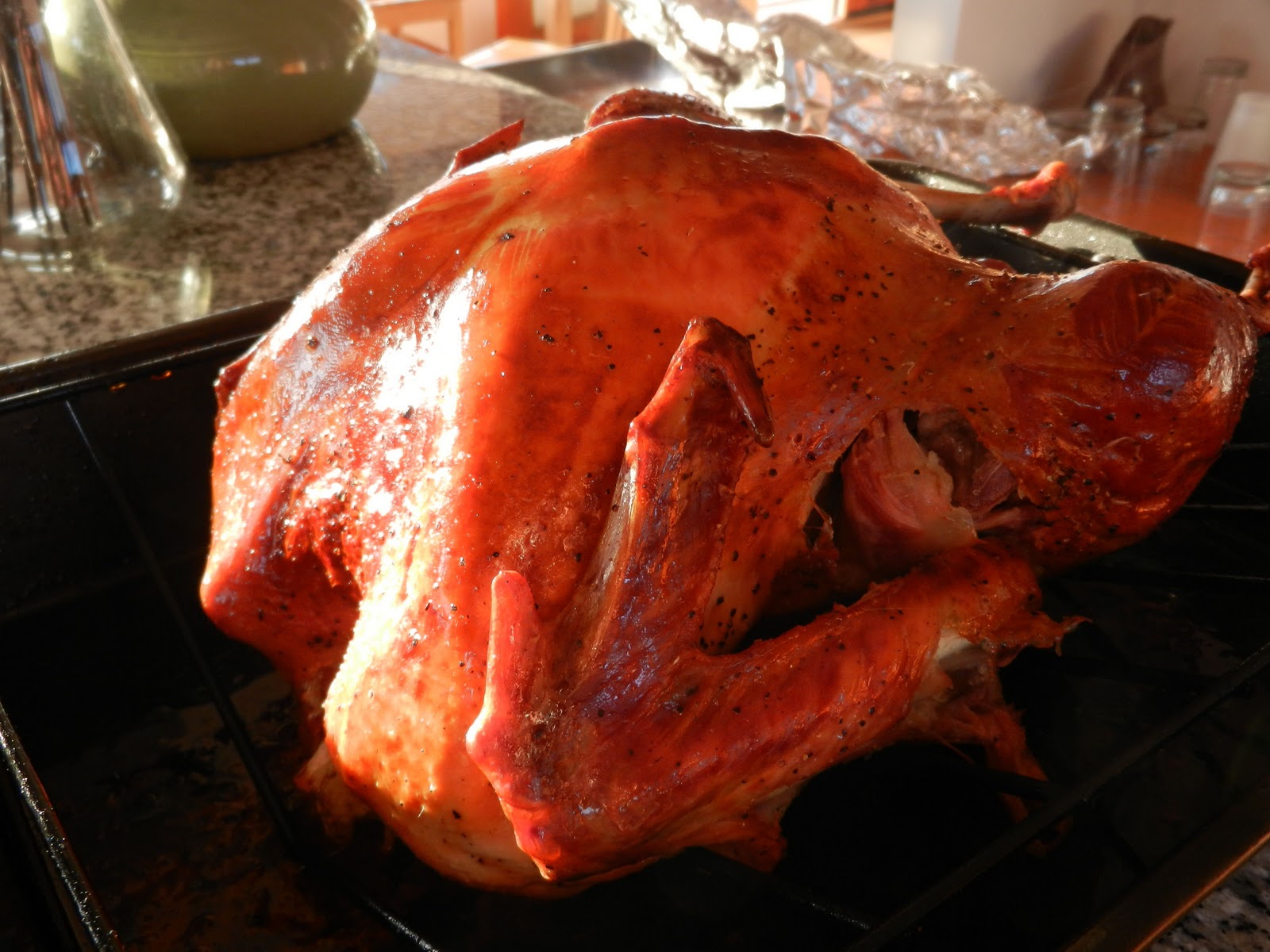
As I said, we’re not going to be home for Thanksgiving Day this year. But I’m still sentimental about turkeys, even though I already made an early Thanksgiving dinner with my boys when I was home on Lummi Island in October. I do highly recommend that
butter and wine shrouded turkey we made.
But when you live overseas, your options are limited both by the availability of turkey and by the size of your oven. We are fortunate in Tunisia that turkeys were introduced here as a Peace Corps initiative decades ago and they are available year-around.
For preparation methods, this is a good time to consult the wisdom of American star chefs who live abroad and one of my favorites is David Tanis. He is the head chef for six months of the year at Chez Panisse, in Berkeley, and then lives a French life for the other six.
I don’t have a small oven here. I was fortunate to inherit an imported GE Profile, regulation American size. It is a completely common oven in the US, but here, it is a prize and I do love it. More the norm, though, is a small oven that can’t hold anything of much breadth.
David Tanis had this problem and writes about a fortuitous French communication error that ended up leading to one of his best Thanksgiving meals ever.
Americans Abroad
One year, I was the one making Thanksgiving dinner in Paris, and for this particular meal, it seemed as if we had every expat in town descend on our little Paris apartment on the rue St. Jacques. There were going to be about forty-five of us in all. So I went to my neighborhood butcher, Charcellet, to get my turkey. They have really good turkeys in France—small but tasty—and Parisians know about la fete americaine. I told the butcher that I wanted him to take the breasts off, take the legs off, and save me all the bones. I told him I needed three birds, see you tomorrow, au revoir.
I came back the next day and he showed me what he’d done; instead of cutting off the legs and breasts, he had deboned the whole turkeys, as only a master butcher can do. I marveled. It turned out to be a brilliant solution because we have the tiniest oven in the world. At first the birds were flat as roadkill, but I put salt and pepper all over them, smeared the insides with garlic and thyme and sage in great quantity, molded them back into a bird shape, and tied them with string to keep them compact.
Long story short, I found that three compact little re-formed turkeys would fit side by side in one roasting pan. When they came out of the oven, I had perfectly cooked roast turkeys with not a speck of unusable anything! And the cooking time was only an hour and a half.
Our friends said it was the best turkey they’d ever had in their lives. You could slice through the body as if it were a galantine—all meat and no stuffing. And this technique applies to every bird in the world. All you need is a good butcher or a lot of patience. Simpler by far is the recipe for the deconstructed bird that follows.
Roasted and Braised Turkey with Gravy
I always prefer to cook a smaller turkey. The secret to great flavor is to season the turkey overnight so begin this process the day before. You can make the broth a day ahead, too.
Have the butcher remove the legs with the thighs attached, cut off the wings, and cut the boneless breast in 2 pieces. While you’re at it, ask him to chop up the carcass for your stock. You’ll be going home with 2 whole legs with thighs, 2 wings, the skin-on breast in 2 pieces and a bag of bones. Make sure to get the giblets, too.
For the turkey
One 12- to 14-pound turkey, cut into six parts (as above)
Salt and pepper
1 bunch sage leaves, chopped
1 small bunch thyme, leaves stripped and chopped
6 garlic cloves, smashed to a paste with a little salt
2 tablespoons olive oil
For the broth
3 pounds turkey carcass and bones (or other poultry bones)
1 large onion, peeled, halved, and stuck with 1 clove
1 carrot, peeled and chopped
1 celery stalk, chopped
2 bay leaves
2 or 3 slices dried porcini mushroom
About 6 quarts water
For the braise
3 tablespoons butter
2 large onions, chopped
Salt and pepper
3 tablespoons all-purpose flour
1 tablespoons tomato paste
1 cup dry red wine
Parsley or watercress sprigs
Put all the turkey pieces out on a big cutting board and season well on both sides with salt and pepper.
Mix the sage, thyme, and garlic in a small bowl and add the olive oil. Spoon the seasoning mixture over the meat and smear it in well. Put the legs and wings in a container, cover, and refrigerate. Wrap the breasts in plastic and refrigerate.
To make the broth, preheat the oven to 400’F. Put the turkey carcass and bones, onion, carrot, celery, and bay leaves in a roasting pan and into the oven. Roast for about 30 minutes, stirring occasionally, until everything is nicely browned.
Transfer the browned vegetables and bones to a big soup pot. Splash a little water into the roasting pan to dissolve any tasty bits left in the pan, and put into the pot. Add the dried mushroom and water and bring to a boil. Skim off the scum, turn the heat down to a simmer, and let it cook slowly for 1 ½ to 2 hours.
Strain the broth through a sieve. You should have about 5 quarts of turkey broth. Cool, then refrigerate; when ready to use, skim off the fat that has risen to the surface.
To make the braise, preheat the oven to 400’ F. Put the legs and wings in a large roasting pan, with enough room so they’re not crowded. Put the pan in the oven and let the parts roast while you prepare the braising liquid.
In a large skillet over medium heat, melt the butter. Add the onions and season them with salt and pepper. Let them cook gently, stirring occasionally, until softened, about 10 minutes. Turn up the heat and let the onions color a little bit.
With a wooden spoon, stir in the flour and tomato paste and mix well. Add the red wine and 2 cups of the turkey broth and bring to a simmer, stirring as the sauce thickens. Gradually stir in 2 more cups of broth.
Remove the pan of legs and wings from the oven. They should be nicely golden, but not too dark. Pour the braising liquid over the legs. Cover the pan tightly with foil and return to the oven. Reduce the heat to 350’ F and let it go for about 1 ½ hours, or until the legs are tender when tested with a fork. Transfer the legs and wings to a cutting board and let them cool slightly.
Strain the braising liquid through a fine-mesh sieve into a saucepan, skimming off any fat tat rises. This will be your gravy. Taste the sauce for seasonings and texture. If it’s too thin, reduce it a bit over medium heat until it reaches a consistency you like. Set aside. (The braise can be done hours ahead or the day before and refrigerated.)
When the turkey parts are cool enough to handle, remove the let meat from the bones in large pieces and tear the meat from the wings. Cut the meat into rough slices and put in a baking dish. Cover and hold at cool room temperature.
Remove the breasts from the refrigerator and let them come to room temperature. The breasts will take only about a half hour to roast, so they can be started up to an hour before dinner in a 375’ F oven. Put them in a shallow roasting pan, skin side up, and into the over. Check at 30 minutes—you want an internal temperature of 140’F (The temperature will continue to rise as they rest.) Let them rest on a platter, loosely covered, for 15 to 30 minutes before carving.
Shortly before serving, reheat the dark meat in the oven for 10 to 15 minute, until heated through. Reheat the gravy and put it in a serving bowl.
Slice the turkey breasts on an angle, not too thickly. Arrange the turkey on a warm platter and garnish with parsley or watercress.
(Tanis, David. 2010. Heart of the Artichoke. New York, Artisan.)
This is going out to all of my expatriate friends all over the world. Happy Thanksgiving with the families you’ve pulled around you.



















 bergamot orange