Spring Capers

Meatloaf

An abiding nostalgia I carry for the 1980s is the ubiquitous restaurant fish saute of butter, olive oil, garlic, a little vermouth, and capers.  I can go right back in my sense memories to a spring break excursion Allan and I took, once we had real jobs, to Long Beach, on the Washington coast.  It was March and we were at the ocean,  so by definition, it was cold, rainy, and windy.   We went there, specifically, to eat at a then famous restaurant called The Ark.  We had received this restaurant’s cookbook for a wedding gift, not long before, and we wanted to have a dining experience there first hand.  This was one of the cookbooks, soon followed by the Silver Palate trilogy,  that moved my cooking thinking beyond hippy basics to cooking that required more technique and relied on fresh ingredients.  I will forever remember walking into the sheltering dining room of The Ark and being greeted with that saute scent that will forever represent essential Northwest cooking to me.

In said 80s, capers were brand new to this Colorado girl, and it’s only at this time in my life that I realize they are native to the Mediterranean.  Thriving in harsh environments, they can be found popping up in the cracks of walls around historic ruins and self-seeding in barren soil.  They are one of those tenacious plants that likes to exist in the trampled terrain that humans and animals have created.  The plant’s berries and leaves are harvested and they are brined or salted for preservation.

Capers are one of the food products we can buy in the Tunisian markets by the kilo, and since I did just that, I am looking for all sorts of uses.  If you are getting tired of winter dishes based on a saute of onions, celery, and carrots, you will be pleased that this meatloaf has none of them.  It gets its flavor foundation from garlic, lemon, parsley, and of course, capers.

Home-grinding turkey breasts, which are plentiful here, is something I do routinely, so I used turkey in this recipe instead of chicken.   I think this recipe works particularly well with white meat and can’t see it as well with ground beef.  Either way, the sauce keeps it moist and brings up the base flavors.  Enjoy this spring-green comfort dish.

Roasted Chicken and Bacon Meatloaf with Caper and Lemon Sauce

Recipe adapted from Cuisine NZ, Issue 162

  • 800g minced free-range chicken or turkey
  • 1/2 cup finely diced bacon
  • 2 cloves garlic, finely chopped
  • 1 cup fresh bread crumbs soaked in 1/4 cup milk
  • Zest of 1 lemon
  • 1 teaspoon salt
  • 3 tablespoons chopped parsley
  • 4 tablespoons extra virgin olive oil
  • 100ml dry white wine
  • 3 tablespoons capers
  • 1/2 cup chicken stock
  • Juice of 1/2 lemon (or to taste)
  • 1 tablespoon butter

Preheat oven to 200 C or 375 F.  Put the chicken, bacon, garlic, soaked breadcrumbs, zest, salt, and 2 tablespoons of the parsley in a large bowl and mix well.  Shape into a loaf shape and put in a roasting pan.  Drizzle with the oil.  Put in the oven and roast for 30-40 minutes or until a skewer inserted produces clear juices and the top is slightly browned.  Remove from the oven and take out of the roasting pan.  Keep the loaf warm.

Pour the fat from the pan and place over high heat.  Add the wine, let it bubble for 20 seconds then add the capers and stock.  Boil until reduced and slightly syrupy.  Add the lemon juice, butter and remaining parsley, taste and season.  Serve the loaf sliced with the caper and lemon sauce over the top.

Serves 6

Mamie Lily

Pumpkin, overex

Recently, the blog Tasting Table posted about a little restaurant in Brooklyn, NY, called Take Root.  I was moved by the story of two married women who make this single seating, 12-course tasting menu restaurant both their livelihood and their artistic passion.  The New York Times review quote on their website gives a sense of the generosity that comes through their food, “It is a rare thing to pay for a meal but feel as if it were a gift”.   The two of them do everything in the restaurant from the ordering, to the prepping, to the serving, to the washing up.  Then they drop into bed at night, have an excellent cup or two of coffee in the morning, and begin it again.

I have experienced a similar spirit at a restaurant in Tunis.  Teaching a comparative religions unit, to my 7th graders, on the monotheistic faiths, we took the first of 3 off-campus visits to observe and experience the religion and culture of  specific faiths in Tunis, this time Judaism.  Jacob, our host at the kosher restaurant/Jewish cultural center began his talk to us, in his heavily French-inflected English, saying the history of the Jews in Tunisia is a love story.  By that, he means both the love of Jews for Tunisia and also the general acceptance they have enjoyed here.

His restaurant Mamie Lily is his mother’s cooking, assisted by some local help.  The neighborhood where it is set, La Goulette, is historically an immigrant neighborhood, being near the Port of Tunis and the fishing piers.  It has the pace and simplicity of the 1950s.  The tiny synagogue is just around the corner and along the street, in between, you could buy all of the artfully displayed fresh produce, the kosher chicken, and the fish with fins that Jewish dietary laws require.  Then, mother Lily puts a loving hand to the cooking, along with a little French technique and Tunisian custom.  She and her staff prepared a set meal for 50 of us and the main course, chicken in a pumpkin sauce with a hint of lemon,  was particularly where the knowledge of local tradition and the cooking skills of Mamie shown through.  Our 12-year olds, being much like 12-year olds the world around, found that sauce to be a challenging new taste, but they got to try it, and I am happy about that.

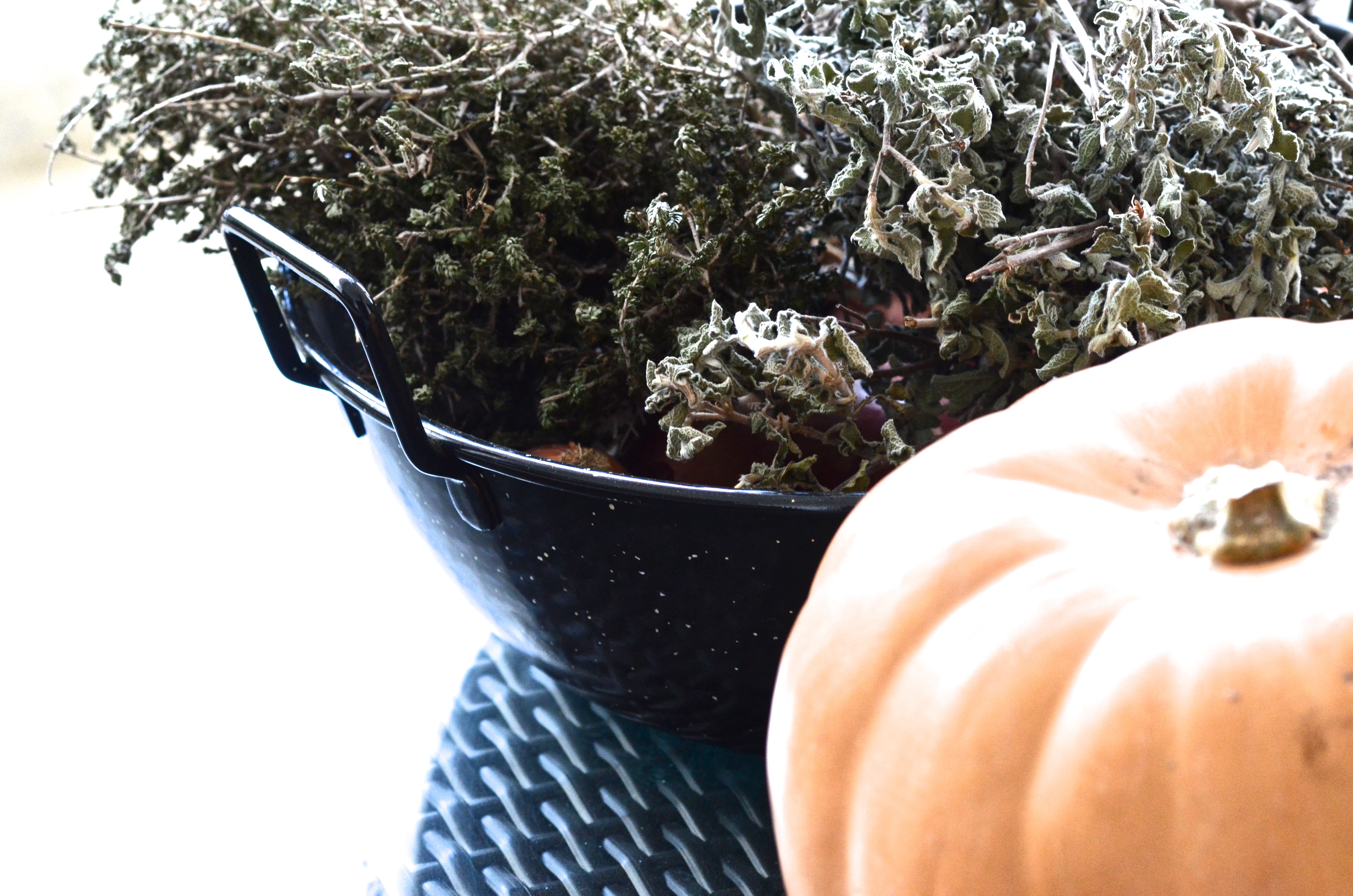
I had been cueing up to make this Bon Appetit recipe for a fresh pumpkin carbonara sauce.  I carried a little of Take Root’s ethos through by blanching and freezing fresh herbs in ice-cube trays and then grating them with a micro-plane grater to use.  I also finished my carbonara sauce with a squeeze of lemon to try and hit that silky sweet/tart balance of Mamie’s sauce.  The thing I think Take Root, Mamie, and I are sharing was summed up in the TT article:  …trying to coax big flavors from humble ingredients.

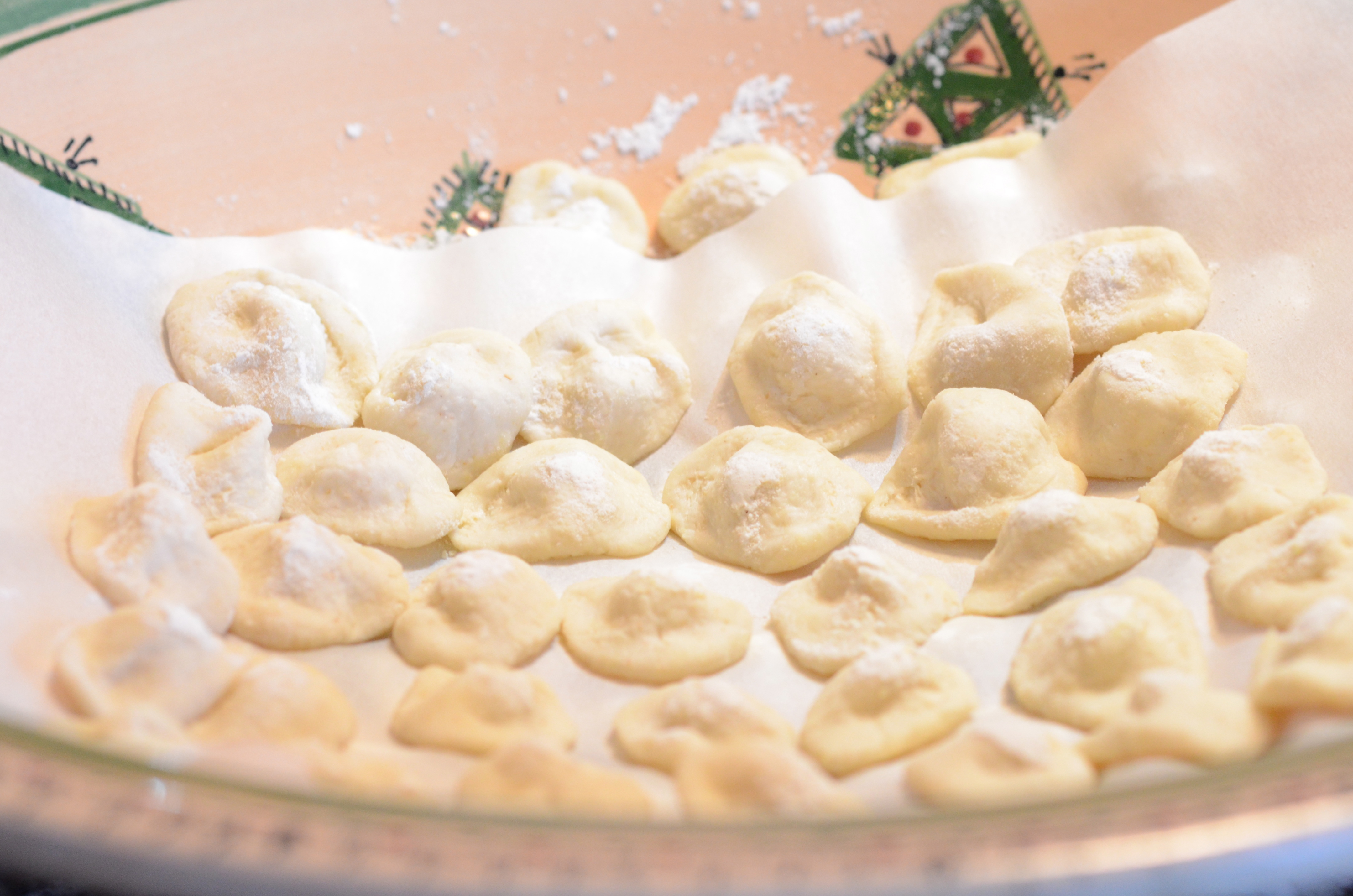
This pumpkin sauce is useful as a sauce or as a soup.  I suggest you make up a huge batch and put a couple of quarts in freezer bags for either use.  Also, take the few extra minutes to make some handmade pasta.  These orechiette are really not difficult and they cook up to make chewy little cups for holding this rich sauce.

oriechette

Pumpkin Carbonara with Pancetta and Sage

Serves 4

  • 2 tbsp olive oil
  • 4oz pancetta, chopped
  • 1 tbsp finely chopped fresh sage or thyme
  • 2-lbs pumpkin, kabocha, or butternut squash, peeled, seeded, cut into 1/2″ pieces (about 3 cups)
  • 1 small onion
  • 2 garlic cloves, chopped
  • Sea salt and freshly ground black pepper
  • 2 cups low-sodium chicken broth
  • 12oz  fettucine or linguine
  • 1/4 cup finely grated Pecorino, plus shaved for serving

Heat oil in a large skillet over medium-high heat.  Add pancetta, reduce heat to medium, and cook, stirring occasionally, until crisp, 8-10 minutes.  Add sage and toss to coat.  Using a slotted spoon, transfer pancetta and sage to a small bowl; set aside.

Add squash, onion, and garlic to skillet;  season with salt and pepper and cook, stirring occasionally, until onion is translucent, 8-10 minutes.  Add broth.  Bring to a boil, reduce heat, and simmer until squash is soft and liquid is reduced by half, 15-20 minutes.  Let cool slightly, then puree in a blender until smooth;  season with salt and pepper.  Reserve skillet.

Cook pasta in a large pot of boiling salted water, stirring occasionally, until al dente.  Drain, reserving 1 cup pasta cooking liquid.

Combine pasta, squash puree, and 1/4 cup pasta cooking liquid in reserved skillet and cook over medium heat, tossing and adding more pasta cooking liquid as needed, until sauce coats pasta, about 2 minutes.  Mix in 1/4 cup Pecorino;  season with salt and pepper.

Serve pasta topped with reserved pancetta and sage, shaved Pecorino, and more pepper.

Do Ahead:  Squash puree can be made 3 days ahead.  Let cool;  cover and chill.

Fresh Pasta

  • 1 cup plus 2 tbsp fine durum flour or all-purpose flour, plus more for dusting
  • 1 cup semolina flour (pasta flour)

Combine durum wheat flour and semolina flour in a large bowl.  Bring a saucepan of water to a bare simmer.  Add 2/3 cup hot water to the flours and mix with a fork until mixture just comes together.  Turn out dough onto a surface lightly dusted with durum flour and knead until smooth and elastic, 8-10 minutes.  Alternatively, mix in a stand mixer fitted with a dough hook for 5 minutes.  Wrap tightly in plastic wrap and let sit a room temperature for 1 hour.

How to form orecchiette pasta

How to form strozzapreti pasta

Want one more delicious but humble recipe from Take Root?  I’m going to be making their Beans and Greens this week.

Small Batches

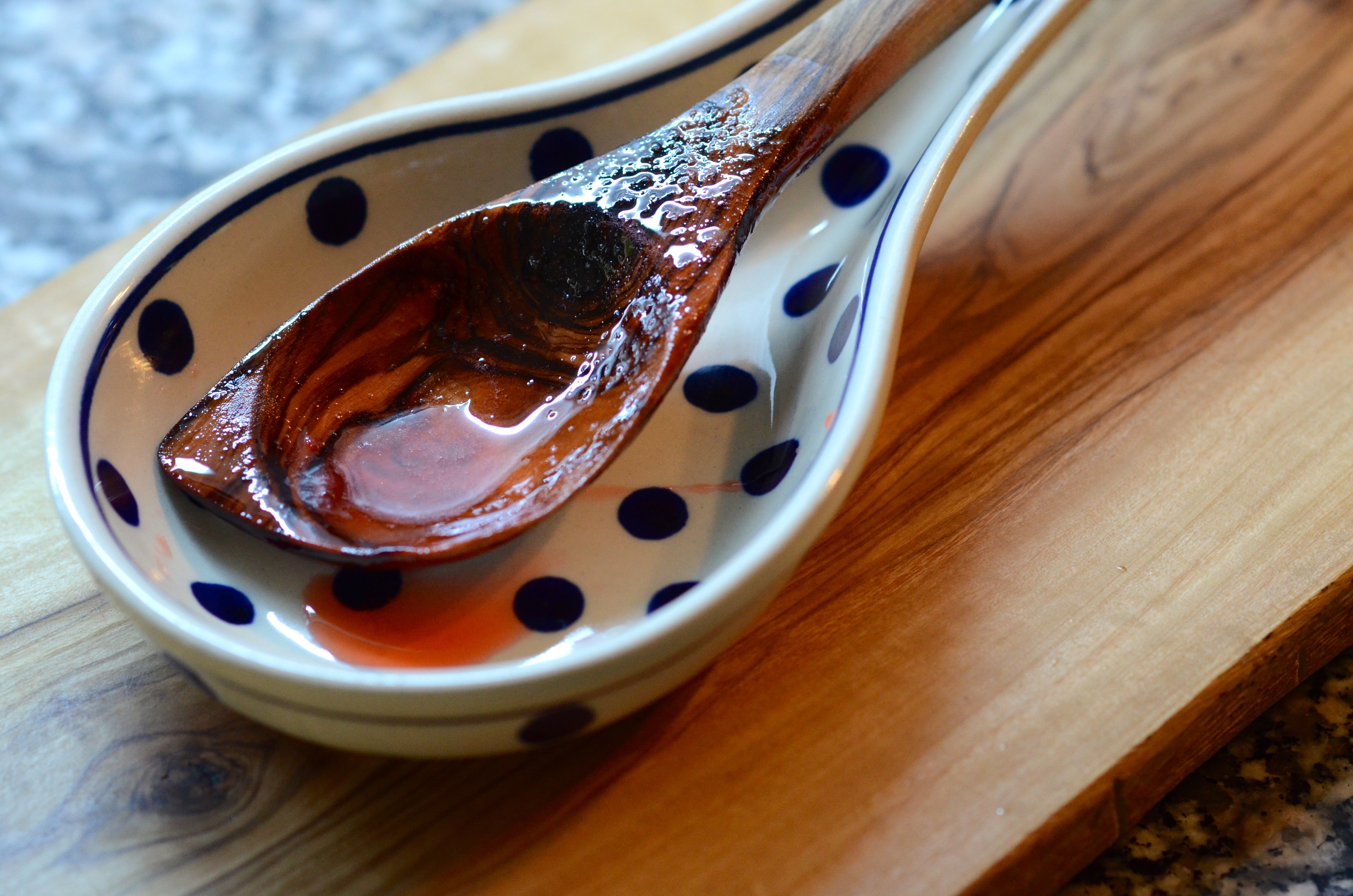
Jam SpoonThese are the months of the school year when teachers will tell you we make the distance with students.  There is just something about the pace of human learning that requires a sizable amount of time to establish rituals and practices that lead to deep consolidation during the winter months.  I am also groping to consolidate a lot of my own learning.  I’ve recently adopted a principle from the short motivational book Do the Work, by Steven Pressfield:  Begin before you are ready.  Whether it’s cooking, trying to take a photograph, or learning a new technology application, I can continue to read and research or I can just try to do it.  Research indicates that we learn quickly that way, but the deep practice of those skills often requires more uninterrupted time than I can make.

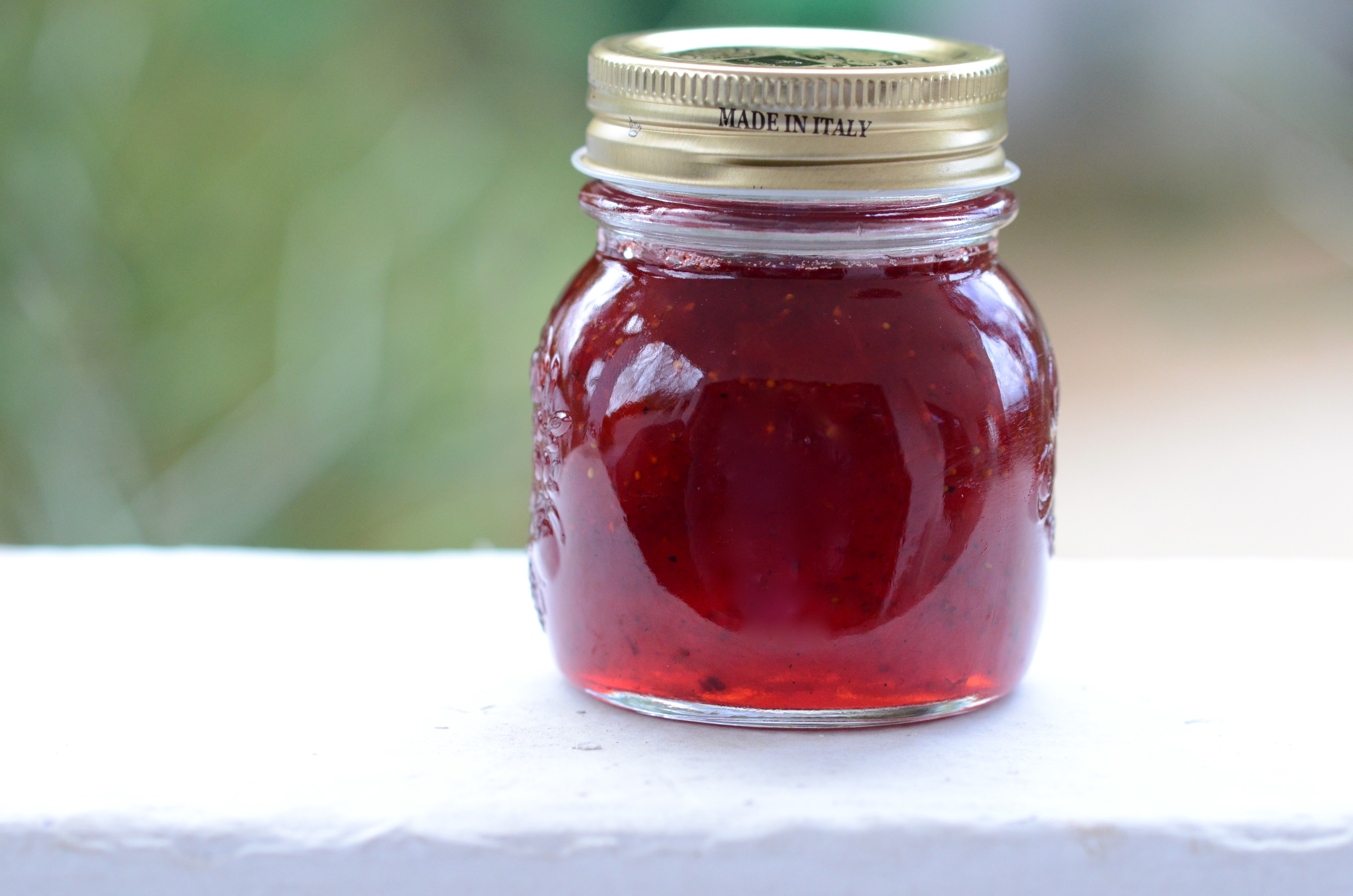
This week, I’ve hit upon the mantra of small batches.  It came to me last Saturday when Allan and I saw rows and rows of strawberry punnets at the market.  We haven’t eaten enough strawberries this season yet, and both of us had a craving for some strawberry jam.  Not long ago, I would have purchased several kgs. of strawberries and then my Sunday would have been pretty much dominated with jam-making.  I had a realization, though.  We didn’t at all want enough strawberry jam to last until next Christmas.  We’re not concerned about saving the strawberry season to distribute throughout the rest of the year.  We just wanted a little jam this week and maybe a little more in another week or so and then a couple of jars to give away.  I made up my favorite Donna Hay jam recipe in a small pot with ingredients I already had on hand:  sugar, a vanilla bean, and a few lemons.  I had some jars with sealable lids, but it could just as well have gone into the refrigerator.  It took no more effort than making a side dish to go with dinner.

Now I’m thinking about other things in life that I can small batch.  Getting to a blog post is one, for sure.  I have several multi-themed blog posts in my draft  file waiting for the right photograph or some finishing writing, but I have a few minutes this afternoon and I’m just going to think small about strawberry jam and its transformational symbolism, that’s all.  Working on another language is another.  It’s hard to find time to lay out the grammar book and have a study session, but with Duolingo on my phone, I can get at least a few words of French out of my mouth in a day, and that feels like progress.  Small batching means enjoying the rewards of a reduced-sized project when the alternative might be no project at all.

Jarred JamI posted this recipe three years ago now, but I think it bears sharing again.  The flavors are bright , and using the natural pectin in the lemon seeds to thicken the jam makes me feel extra self-satisfied.

Basic Strawberry Jam
donna hay, issue 55
1 kg strawberries, hulled and halved
1 tablespoon water
1 vanilla bean, split and seeds scraped
1 kg white sugar
½ cup (125 ml) lemon juice
2 teaspoons lemon seeds, wrapped in a piece of muslin
Step 1  Place the strawberries and water in a jam pan or large, deep frying pan over medium heat and cook for 15-20 minutes, stirring occasionally, or until the fruit begins to beak down.
Step 2  Add the vanilla, sugar and lemon juice and tie the muslin bag to the handle of the pan, ensuring it is immersed in the jam.  Stir until the sugar is dissolved.  Bring jam to the boil.  Place a sugar thermometer in the pan, reduce heat to medium and simmer for 10-15 minutes or until temperature reaches 105 degrees C (225 F).
Step 3  While the jam is simmering, use a large metal spoon to skim any foam from the surface and discard.
Step 4  Remove the vanilla bean and carefully pour the hot jam into sterilized glass jars.  Seal with the lids and cool.  Makes 4 cups (1 litre)

Salad Genetics

I replanted our salad garden terrace in January and it got a fairly slow start due to some chilly, rainy weather.  I’m not super finicky about putting in the greens seeds.  They are so small that I just divide the nicely prepped planters into sections, sprinkle over a few pinches of seeds, and lightly ruffle them through the soil.  I figure I can always rearrange them later when they’ve gotten established.  My concern is always that I will weed out my seedlings before I recognize what they are, so I put in some markers.

Strangely, the markers immediately started getting dislodged and scattered around the garden.  I would come home from work and find two or three of them plucked up and lying in the wrong section.  One of them went missing entirely for about two weeks until I found it slightly buried.  In my mind, I was blaming all sorts of unseen nemeses, mostly focused around our maid and some workers who had been repairing the terrace door.  I wondered, Why, why would they tamper with my markers?

Then, I remembered the particularly fat dove I had chased off several times for fear he was eating my seeds.  It must have been the dove that had made a little game with the markers.  I put them back where I recalled they should go, but following some rain and near 70 degree temperatures last weekend, all of the seedlings popped out with their familial characteristics and I realized I needn’t have worried about recognizing them.  They look exactly like their families.  Here are some family portraits:

Bok Choy 2
Poor little bok choy, you’ll go through life with your father’s big, round ears.
Swiss Chard 2
The Swiss chard kids. You can hardly tell one from another, all tangled together like a pack of puppies.
Curled Kale 2
Pretty little curled kale has her sister’s hair.
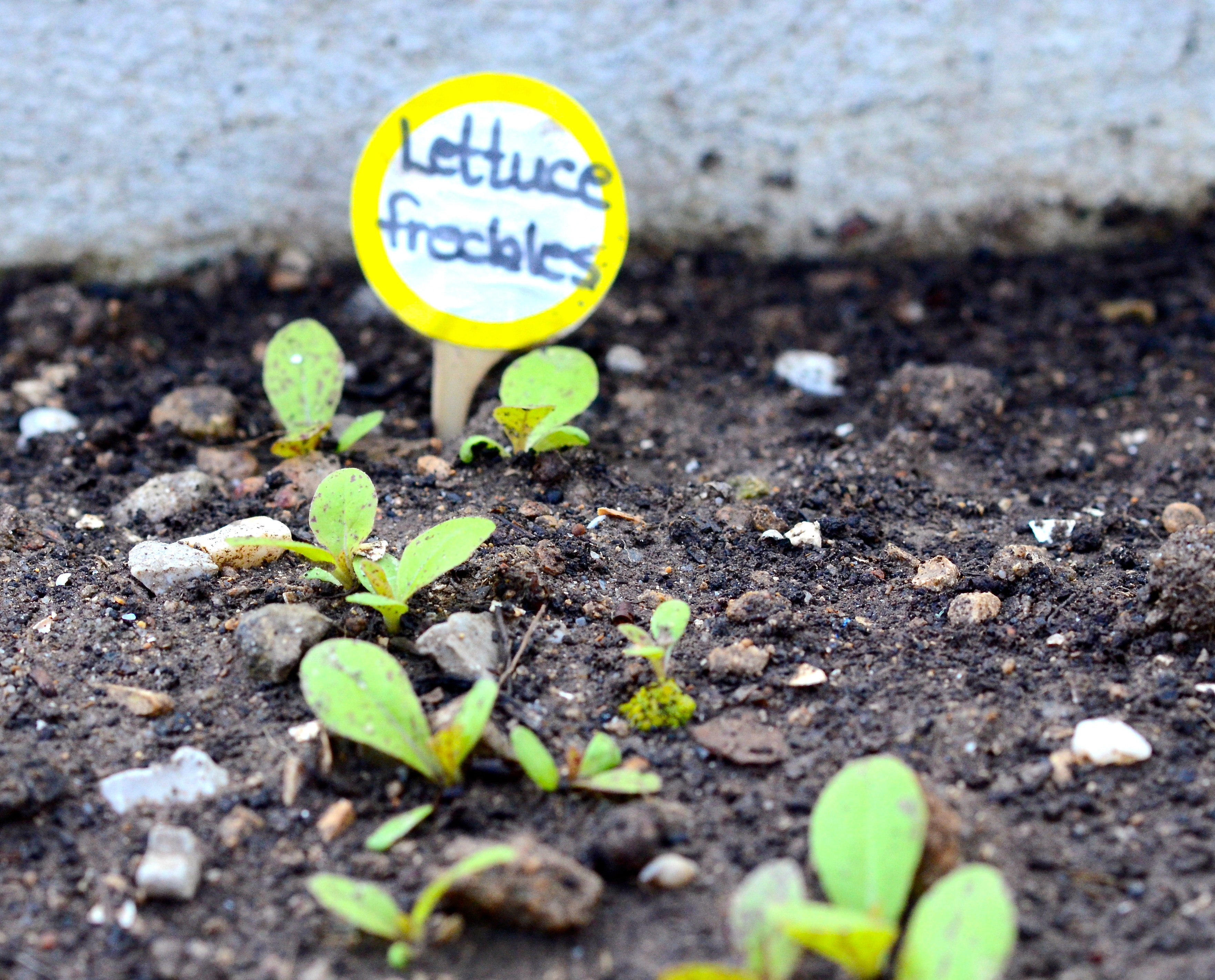
Freckles Lettuce
Lettuce has her mama’s freckles.

These greens are still a couple of weeks away from eating, but we have some perfect mache or lamb’s tongue lettuce from the local farms.  Getting a little dreamy about our planned spring break trip to Sicily, I made this dish from the cookbook Love Italy by Guy Grossi.

Lamb and Salad

Costoletta di agnello in crosta

Herb-crusted lamb cutlets with mache and mint salad

  • 12 lamb cutlets, French-trimmed if possible, excess fat and sinew removed
  • 3 tbsp finely chopped flat-leaf parsley
  • 2 tbsp finely chopped rosemary
  • 1 tbsp finely chopped sage
  • 1 tbsp finely chopped thyme
  • 1 tbsp grated parmesan
  • 200g dried breadcrumbs
  • Sea sale and cracked black pepper
  • 100g plain flour
  • 2 eggs, beaten
  • 200ml olive oil

Mache and Mint Salad

  • 100g fresh shelled peas
  • 100g mache leaves (lamb’s tongue lettuce)
  • 20 mint leaves
  • 100ml extra virgin olive oil
  • 1 tbsp white wine vinegar
  • 2 tsp lemon juice
  • 1 shallot, minced
  • 50g marinated goat’s cheese or feta
  • Sea salt and cracked black pepper

1.  Lightly beat the lamb cutlets until they are about 5mm thick.

2.  Combine the herbs, parmesan, and breadcrumbs in a bowl and mix well.  Check the seasoning, adding salt and pepper to taste.  Place the flour in a shallow bowl and the eggs in another.  Lightly flour a cutlet, shaking off any excess, then dip it into the beaten egg.  Place the cutlet in the herb and crumb mix, pressing the crumbs onto the meat to coat completely.  Repeat with the remaining cutlets.

3.  Heat the olive oil in a large frying pan over medium heat and add the cutlets.  Cook for 1-2 minutes on each side until golden brown.  Drain on paper towel.

4.  Meanwhile, bring a saucepan of salted water to the boil and add the peas.  Simmer for about 1-2 minutes, then drain immediately and refresh in cold water.  When cool, drain the peas again and place in a large bowl with the mache and mint leaves.

5.  Make a dressing by whisking together the olive oil, vinegar, lemon juice, and shallot.  Pour over the leaves and mix well.  Crumble in the goat’s cheese or feta and check the seasoning, adding salt and pepper to taste.

6.  Serve the herb-crusted lamb cutlets with the mache and mint salad alongside.

The Sunday Braise

BraiseWe’ve got some busy days coming up.  First of all, our architects are returning this week and you know what they will be bringing?  Site renderings!  They came twice last fall and interviewed every possible stake-holder in the school about what they would like to see in our new school building.  They’ve done aerial views and studied the engineering challenges of the site.  Now, it’s time to get our first look at the baby.  It’s going to be pretty thrilling, but it will entail a bunch more meetings.

Second, Allan and I are starting proper French class.  We’ve worked here and there on our own tutorials these past years, but we’ve always meant to get something consistent on the calendar.  Tuesdays after school, now, we will be in an actual class with some other colleagues (accountability…), a textbook, and homework.  Gulp.

Then, Allan has started co-coaching the soccer team which keeps him at practice until 5:00 PM.

This is all just by Wednesday, and I knew that if we wanted to eat proper food this week, I  had to get it not only planned ahead, but actually cooked, today.  Even before reading Michael Pollan’s book Cooked last spring, in which he dedicates an entire section to his Sunday braises, I had hit on that pattern, too.  The practically hands-free cooking, that allows you to get a few other things ready for the week, is reason enough to put a braise in the oven, but its beauty is multi-faceted.  First, you can make it using any meat (or none), plus any vegetables (or none), plus any liquid.  I generally don’t put beans in, but today I had some freshly-shelled fava beans, so I cooked them together.

The sequence is always the same.  You brown the meat, remove it and cook the vegetables until they are softened, then put is all back together and add some liquid:  water, stock, wine.  Cover it tightly and cook it for several hours on low, low heat, just so little heat bubbles are surfacing, slowly.  For the last half hour or longer if you choose, remove the lid and allow the liquid to reduce and the ingredients to caramelize.  You can eat the braise immediately or cool it and put it in the refrigerator.  The dish actually improves in flavor by 1 to 3 days in the refrigerator before serving, and you can reheat it all or just in servings.

A braise is a perfect way to use up vegetables and other flavor enhancements at the end of a week.  And now my tragic confession:  I was sorting through the fridge, making decisions about cooking components, when I came across my bottle of lemon olive oil that was basically finished.  Acting efficiently, I filled the bottle with warm water to soften all of the remaining lemon pulp and the chilled oil and ran it down my garbage disposal.  Not until I was building the braise did I regret that I hadn’t put all of that flavor into my pot.  The lemon pulp would have completely dissolved into the sauce and been absorbed by the meat and fava beans.  I won’t make that mistake again.  From now on, the bottom of the bottle goes into the braise.

Chicken and Fava Bean Braise

Ingredients

  • 8 chicken thighs or other pieces
  • Rosemary salt
  • Freshly ground pepper
  • Hot paprika
  • 6 Tbsp. olive oil
  • 3 leeks, chopped
  • 2 shallots, chopped
  • 3 large cloves of garlic, chopped
  • 2 carrots, chopped
  • 1 fennel bulb, chopped
  • 2 mild green peppers, chopped
  • 2 cups parsley, chopped
  • 2 bay leaves
  • 3 cups fresh fava beans, shelled
  • 2 cups chicken stock
  • 1 cup white wine
  • 1/2 cup of lemon olive oil pulp (optional)
  • Fennel fronds
  • Cured black olives
  • Grated lemon rind

 Rub chicken pieces with salt, pepper, and paprika.  Heat oil in heavy-bottom, Dutch oven and brown chicken on all sides.  Remove chicken from pan.  Add leeks, shallots, fennel, and garlic.  Cook until vegetables are beginning to soften.  Add peppers, parsley, bay leaves,  and fava beans.  Soften slightly.  Place chicken on top of beans and vegetables.  Add chicken stock, white wine, and lemon olive oil pulp, if using.  Cook at 300 degrees for 2 hours, monitoring frequently for liquid level.  Add more if needed.  Remove lid, increase heat to 350 degrees.  Cook until liquid is reduced and ingredients have caramelized. Serve immediately, or cool and chill in the refrigerator for 1-3 days.   Garnish with fennel fronds,  olives, and lemon zest, if using.

Winter Bounty

Salad

Winter is the most vibrant growing season in Tunisia.  Think San Diego to get a bearing of a comparable US climate zone.  We’ve got cool weather, but never (pretty much) freezing.  I think we had ice on our car windows once or twice in the morning in my 3 1/2 years here.

I’m getting back involved in the social life of our community.  Friends have been over to the house for meals and brewing and everyone seems to bring me a bunch of something from their garden.  But they have a bumper crop if they’ve got any, so  I’ve gotten huge sacks full of lemons and arugula, spinach transplants to go into pots, a pot of thyme,  and a bundle of just-cut roses.  It’s all wonderful, and I get to indulge in cooking, using mass quantities of these wonderful ingredients.

I’ve made preserved lemons before, and they are nice, though I can buy preserved lemons in local shops any time I want them.  Saveur magazine presented a similar but different idea which I tried this time: lemon olive oil.  Here are their very loose directions for making it up.

Lemon Olive Oil

“Throw a lemon- rind, pith, seeds, the whole shebang- into a blender with olive oil, blitz the heck out of it, and what do you get?  A bright and bracing emulsion that’s terrific in everything:  tossed with roasted potatoes, added to marinades, even mixed into pancake batter for some zip.  Refrigerated, it can keep for three weeks.”

I quartered a medium-large lemon, picking out all of the seeds I could see,  and trimmed any blemishes from the peel.  Then, I pureed it with about 2 cups of extra-virgin olive oil.  The emulsion holds perfectly.

Lemon Olive Oil

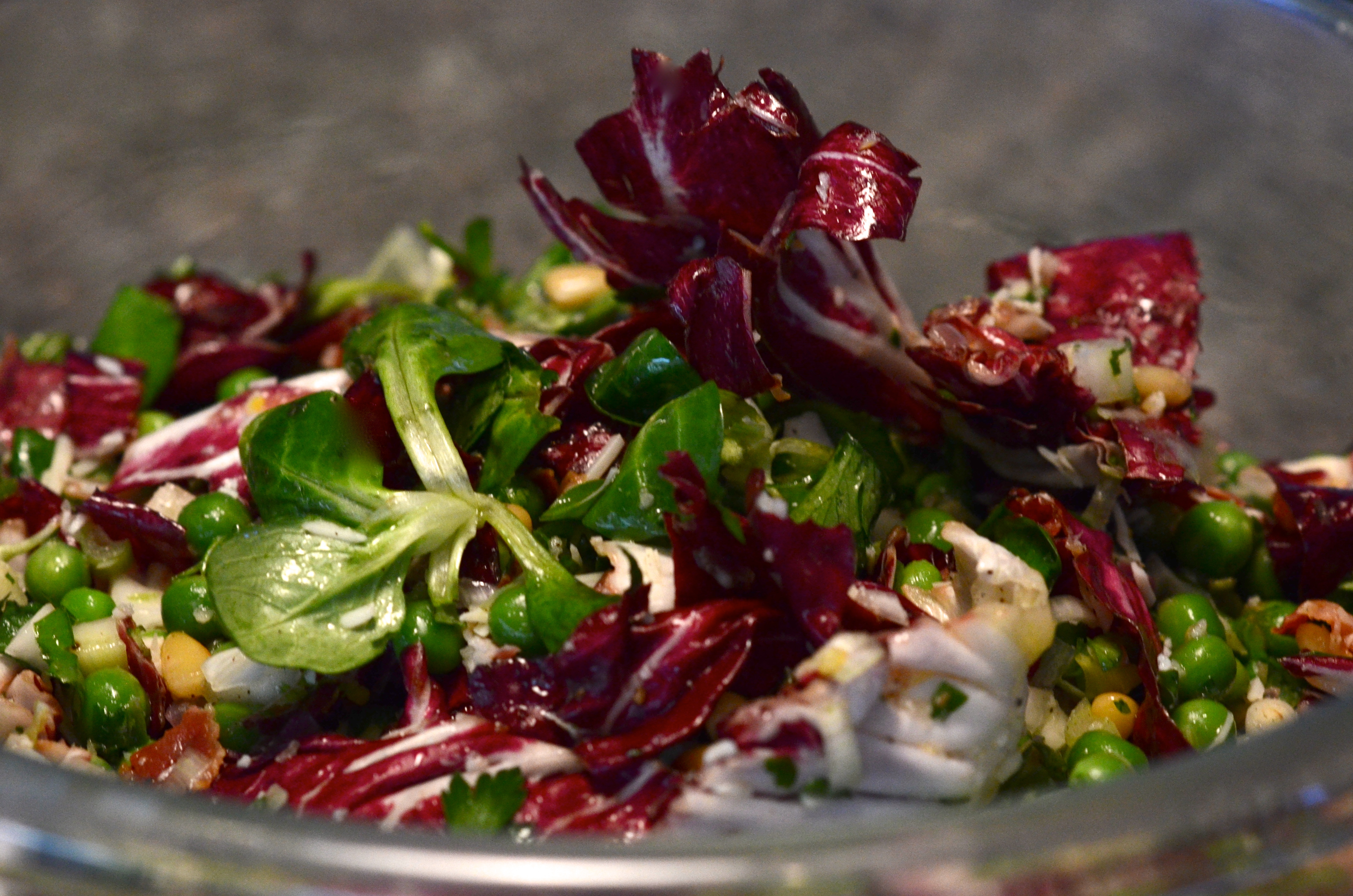
And now, here is the recipe,  from the header photo, which is perfect for using large quantities of the freshly-shelled peas, fennel, and other greens that are thriving in our cool winter sun. This is a vintage recipe from Saveur, April 1996,  but it was recommended by The Canal House as one from Saveur’s 20-year past that influenced them.  I know that anything The Canal House adopts as a touchstone recipe is one I need to make my own.  (Oh, watch the video on that link.  It will make you desperate to run outside, collect fresh food, cook it simply, but brilliantly, and share it with some lovely friends.)

Cooked and Raw Winter Salad

Serves 8-10

  • 6 slices bacon, roughly chopped
  • 1/2 cup olive oil
  • 1/2 cup pine nuts
  • 2 shallots, finely chopped
  • Kosher salt and freshly ground black pepper, to taste
  • 1 16oz. package frozen lima beans
  • 1 16oz. package frozen peas
  • 1 cup roughly chopped mint
  • 1 cup roughly chopped parsley
  • 1/3 cup grated parmesan
  • 7 scallions, finely chopped
  • 1 bunch watercress, roughly chopped
  • 1 head bibb lettuce, cored and torn into small pieces
  • 1 medium bulb fennel, finely chopped, plus 1/4 cup roughly chopped fronds
  • 1/3 cup lemon juice

1.  Heat bacon in a 12″ skillet over medium-high heat; cook until crisp, about 6 minutes.  Using a slotted spoon, transfer bacon to paper towels to drain; set aside.  Add 2 tbsp. oil to pan;  return to medium-high heat.  Add pine nuts, shallots, salt, and pepper;  cook until shallots are soft, 2-4 minutes.  Transfer mixture to a bowl;  set aside.

2.  Bring a large pot of salted water to a boil.  Cook lima beans and peas until bright green, about 1 minute.  Drain and transfer to a bowl of ice water.  Drain and spread on paper towels to dry;  transfer to bowl with pine nuts and shallots.  Add reserved bacon, remaining oil, mint, parsley, half the parmesan, the scallions, watercress, lettuce, fennel and half the fronds, lemon juice, salt, and pepper;  toss.  Garnish with remaining parmesan and fennel fronds.

My modifications:

I prefer to use pancetta in place of regular bacon.  The flavor is lighter and saltier, and I think it goes so well with fennel.  We can get freshly-shelled peas easily now, so I used all fresh peas and blanched them quickly to bring up their color.  In place of watercress, I used a combination of mache and arugula.  I also used my new Lemon Olive Oil  in place of the oil and lemon in the recipe, minus the amount for sauteing.  Taste to see if you need any more lemon at the end to brighten the flavor.  Canal House encourages making any substitutions that work for you.  Bonus:  This salad is brilliant lightly sauteed and tossed with pasta and extra parmesan on Day 2.

Peas
A pile of peas at the Sunday market.

Ah, Artichokes

Artichokes

I am back home in Tunis.  What makes a place a home is interesting to assess.  This is my home because I am invested in my choice to live here.  I feel productive and creative when I’m here.  It is where the rest of my wardrobe and the baby pictures of my sons reside.  It’s not my home because I work here.  Making a home here is a decision I made and  I am fortunate enough to have two true homes, each one fulfilling a different side of myself.

It is interesting coming back to a place that has been essentially created in my image after an extended time away.  I notice this same thing every time I come back to Lummi.  It is evident that the inhabitants haven’t completely adhered to the design concept, in my absence.  Groupings that were excruciatingly evolved have been pushed to the walls, separated from their counterpart furnishings that give them context and charm.  The second I enter the house, I start pulling things a little forward, more toward another item.  It’s a thing that all home designers do that is hard to explain.  It is creating a balance between objects and white space that makes the whole feel calm and animated at the same time.

I am deep in the world of Paul Bowles at the moment reading The Sheltering Sky, a classic book a friend sent me to read in my recovery.  I marked a small quote in the context of travelling, “It takes energy to invest life with meaning…, ” and I think that this is so true about all of life.  One has to really notice, and try to understand, and create something intentional… or not.  Sometimes we just don’t have the energy.  But I have been noodging things for a few days, and the house is starting to feel right again.

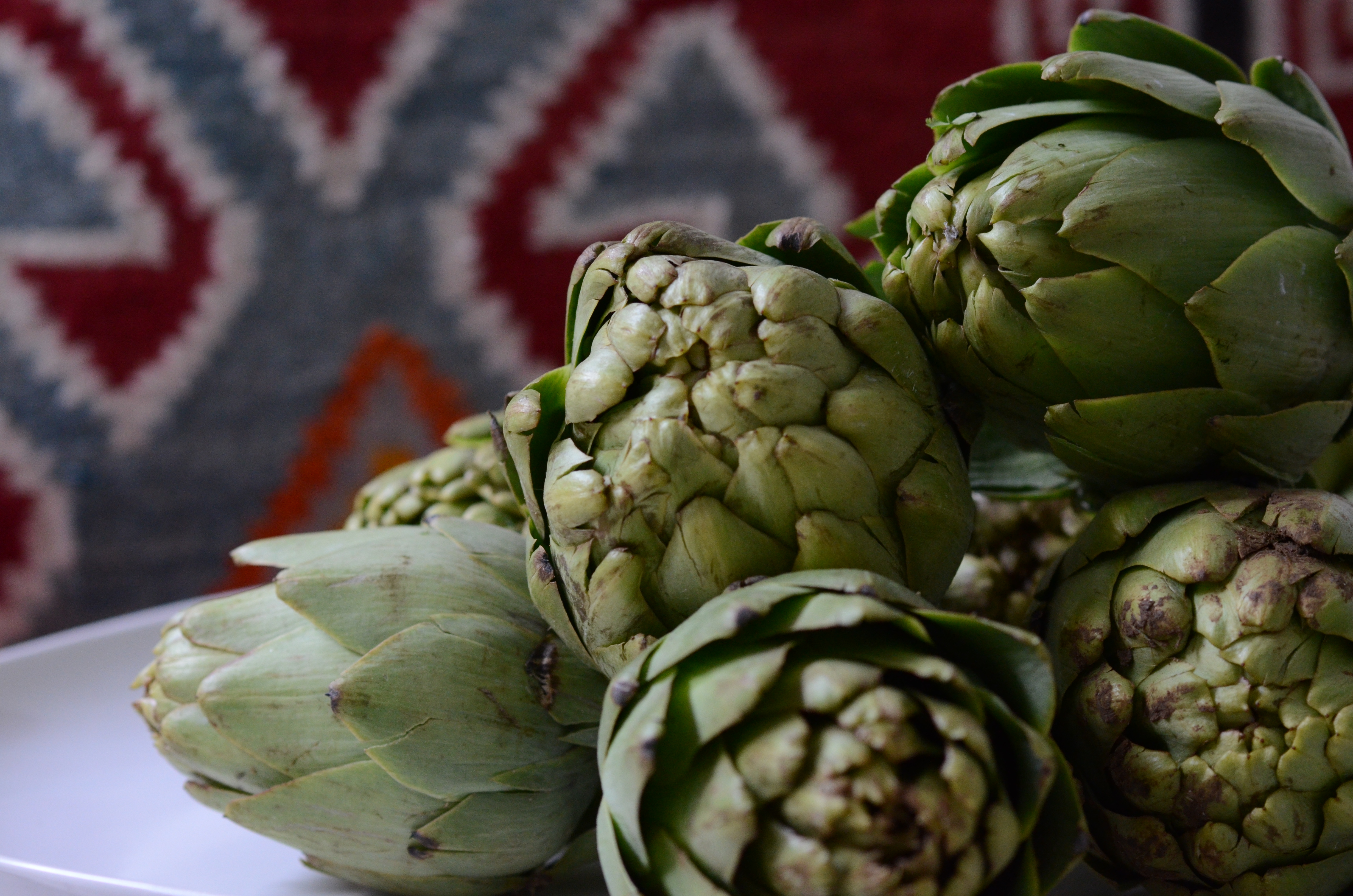
While I was away, in “the land of everything”, I absolutely eschewed 4 foods:  oranges, strawberries, fennel, and artichokes.   I knew that when I landed back in Tunis, it would be high season for these treasures, and I didn’t want to dull my palate for them.  I am ready now to roll up my sleeves and make the most of our winter produce season, which, surprisingly,  is the most vibrant  of the year.

It is time to restock the larder.  This could mean just putting away the suitcases full of hoarded food items we brought back with us, an expat holdover practice we can surely start to take a look at since we can get so much of what we need and even want here.  We can get prewashed radicchio now, for heaven’s sake.  But what I’m talking about is the cooking bases that will give our meals depth of flavor on demand.  I am beginning first with some marinated artichokes.   Gabe did a nice job last fall of stocking his larder on Lummi with home-canned jars of salsa, pickled jalapenos, onions, and pickles.  When we were with him, we chomped our way through his stores, like vinegar-crazed termites.  Our favorite was his pickled jalapenos which we used liberally on scrambled eggs to nachos.  While I will be able to get all of the fresh artichokes I want in the coming weeks, and cheaply, I want to have some on hand that have that acidic base to brighten dishes in a different way.  Saveur magazine has the basic recipe.  Rather than process these in sealed jars, I’m going to try to keep them on hand in the refrigerator, refreshing the batch as needed. They will keep well for weeks, if continually covered with oil.

Marinated Artichokes

Marinated Artichoke Hearts

Adapted from Saveur magazine, February 2009

Multiply recipe as needed.

9-oz. artichoke hearts (Here is a great step-by-step for trimming a raw artichoke to get to the heart.)
1/2 cup extra-virgin olive oil
1 tsp. kosher salt
1/2 tsp. dried thyme
1/2 tsp. dried oregano
1/4 tsp. crushed red chile flakes
2 tbsp. fresh lemon juice

1. Rinse artichoke hearts under cold water. Combine artichokes, oil, salt, thyme, oregano, and chile flakes in a 1-qt. saucepan set over medium-low heat. Cover and cook, stirring occasionally, until the flavors meld, 10 minutes.

2. Let cool to room temperature and stir in lemon juice. Serve or refrigerate in a covered container for up to 1 week.


And since I have suitcase-delivered, extra-sharp cheddar cheese and Tobasco sauce,  at the moment, I used my first batch in this recipe from Sunset magazine, part of their “25 All-Time Favorite Test Kitchen Recipes”.  As with all food, you can substitute a processed product, but when you make it yourself, it will have layers of flavor you couldn’t achieve otherwise.

Artichoke Nibbles

From Sunset magazine, January 2014

Makes 40

  • 2 jars (6 oz. each) marinated artichoke hearts*
  • 1 onion, finely chopped
  • 1 garlic clove, minced
  • 4 large eggs
  • 1/4 cup fine dried bread crumbs
  • 1/2 tsp.  each pepper and dried oregano
  • 1/4 tsp.  hot sauce, such as Tabasco
  • 2 cups (8 oz) shredded sharp cheddar cheese
  • 2 tbsp.  minced parsley
  1. Preheat oven to 350 degrees and put a 10-in. cast-iron skillet into oven to heat.
  2. Drain marinade from 1 jar of artichokes into a frying pan.  Drain remaining artichokes;  reserve marinade for other uses.  Chop all artichokes.
  3. Heat marinade in frying pan over medium eat.  Add onion and garlic and cook, stirring, until onion  is soft, about 5 minutes.
  4. Whisk eggs in a bowl to blend.  Stir in bread crumbs, pepper, oregano, and hot sauce.  Stir in cheese, parsley, artichokes, and onion mixture.
  5. Remove skillet from oven.  Protecting your hands, wipe it quickly with an oiled paper towel.  Pour in custard and bake, uncovered, until custard feels set when lightly touched, about 30 minutes.  Let sit at least 15 minutes before cutting into 1-in. squares.

*Either make your own marinated artichokes or buy artichokes in a oily marinade, such as Cara Mia brand.

MAKE AHEAD up to 1 day, chilled.  Reheat, uncovered, 12 minutes at 325 degrees.

And a Frugal New Year


Flageolet

I hope you are having a peaceful New Year’s day.  When we can, we like to stay put on this day, somewhere, and enjoy the present.  I am frequently drawn to French cooking around this time.  The tension between the austerity and decadence of French cuisine suits my winter mood.  I love having some high quality ingredients on hand, maybe a bag of local mussels or lamb shanks, and some interesting winter vegetables.  It’s a satisfying accomplishment to grow them into a redolent bouillabaisse or osso buco to warm us up after an island walk or polar bear swim.

That may not sound frugal to you, but my idea of frugality doesn’t suffer a bit in quality.  I think we should source the highest quality of everything when we make purchases, but then stop purchasing when we have enough, and make the fullest use of everything we have.

I’ve just spent the longest amount of time I’ve ever had at our Lummi house and I will admit that there were days when it was closing in on me a little.  We ask ourselves a lot if this is where we can spend our life when we are retired.  It is beautiful, but it has challenges, for sure.  I have found over and over again that the answer to dissatisfied thinking about my possessions is to go through the following sequence:  look around and begin to fix stuff that’s broken, clean stuff that’s dirty, especially windows, get rid of things we don’t need or want, and then apply our creativity to make the most of our home, our wardrobes, and our refrigerator.  We have a 5 star life when we attend to those things and having a bigger house somewhere else wouldn’t make any of that better.

I’ve had two observations this season that are driving my motivation for 2014.  This first was at a holiday dinner party.  During the clean up, my jaw dropped to see the hostess dump the carcass, still shaggy with meat, of a 20something pound turkey into the garbage can.  I’m still thinking about that and what I maybe should have said.  There went all of that goodness and nutrition to the landfill, and then when a recipe calls for chicken flavor, a bouillon cube or canned broth will be purchased.  In contrast, I read a quote from the Bon Appetit January 2014 issue.  One of the editors, Andrew Knowlton, hosted a lunch for four well-known, successful American chefs, facilitating a conversation about eating well.  Daniel Patterson, who has been a chef for 30 years, said, “At home I cook for little kids, so I don’t make 12-course tasting menus.  We have a lot of one-pot meals.  We roast chicken, eat it, and then all the bones go in the slow-cooker overnight for stock.  In the morning, the bones go out, beans go in.”  Glorious.

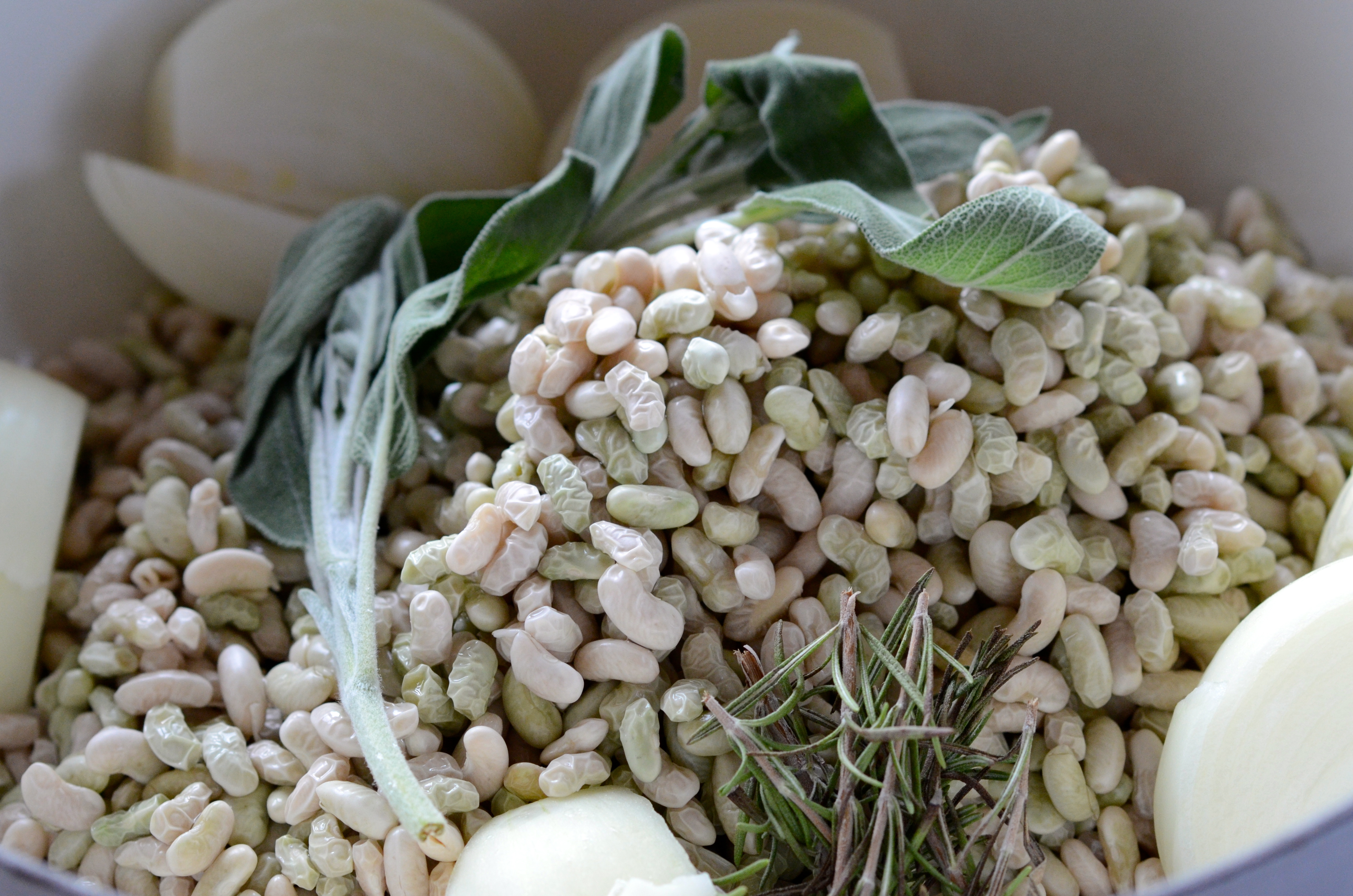
I roasted a duck for our New Year’s Eve dinner last night and while I was making the dinner, I got my slow cooker all set up with onions, celery, carrots, bay leaves, and pepper corns.  While we were cleaning up I carved off any remaining chunks of meat and then put the carcass in the slow-cooker, covered it with water and left it to cook overnight.  As much as I love the simplicity of just adding beans in the morning, I needed to do a little more than that.  I strained the stock and discarded the solids, composting the vegetables, then I put the stock in the fridge for several hours to cool so I could skim off the fat before continuing.  While the stock was cooling, I soaked the beans.  Finally, I put the soaked and drained beans, chopped onions, sprigs of herbs, and stock into a heavy bottom pot.  I also added leftover duck from the night before to make a heartier dish, a mock cassoulet using these pretty green flageolet beans, common to French/Mediterranean cooking.  I checked the liquid level frequently and stirred from time to time so the beans didn’t boil dry and stick to the pan, adding additional water as needed.  They were finished when the beans were soft and had a creamy consistency.

Have a happy 2014, making the most of the life you have.

Best of the Season

Trifle

I’ve just completed my first holiday season in the US, right from Thanksgiving through Christmas,  in 14 years.  It is a peculiar and luxurious thing to live in a foreign country much of your year.  You feel a little like you walk around wearing a cloak of invisibility.  You can observe the culture around you, but the culture is not generally targeting you for a response.  Billboards, advertisements on the radio and television, signs in the stores pass through my vision without recognition because I either don’t completely understand the language they are in, or because I am not their target audience.  I don’t have long black hair, so the shampoo commercial advertising extraordinary darkening and strength-building properties doesn’t tempt me.  I am not even likely to spend much of my clothing budget locally, so I’m not tempted by the sale banners in the stores.  The tone, the content, and the motivation for buying in another country are different and I am not who those advertisers have in mind.  But watch out.  When I get home, I AM the targeted consumer, and I really feel it.  Commercials that make me cry, like the one featured below, know exactly who they are talking to, who has the expendable income, and what pulls ,specifically, my strings.  Pop-up advertisements on Internet pages increased exponentially in the weeks following Thanksgiving and with increasing specificity.  If you have ever read the young adult novel Feed, I tell you it feels like we’re not far from a world where marketing is hardwired into our brains and shopping is as easy as completing a thought.  Without my work to keep me distracted and focused on things nonholiday, I was a sitting duck for this commercial bombardment, though I tried to keep it at arm’s length as much as I could.  From what I did peruse, however,  the following cultural sampler made my list of Christmas 2013 takeaways.

Best Cookie:  The boys and I had planned to make a quick road trip to Montana to visit my family before Allan got here.  Montana, however, just set a record for snowfall amounts in the month of December.  Given that I wasn’t in good enough shape at that time to hike 10 miles in a snowstorm to the next town if we had car trouble, and our vehicle is getting old, and we have a 5 month old puppy,  we decided not to go.  We spent that week baking cookies to send to them, instead.  Our favorite, in the end, was the least likely:  Rosemary and Toasted-Caraway Shortbread.  The balance of toasted seeds, camphory rosemary, and butter was so pleasant and went extremely well with other cookies, especially these chocolate-pistachio sables (we made ours with pecans instead of pistachios).

Best Movie:  The standard Christmas music and movies were overplayed and over-referenced all season.  It really got cloying.  When we returned home from our family Christmas party on Christmas Eve, we just couldn’t face The Christmas Story, again.  Anton made a daring suggestion from Netflix:  In Bruge.  Reading the summary, you probably wouldn’t think you would like to watch this at Christmas, but it was a real palate cleanser.  First of all, Allan and I love the city of Bruge and knew all of the cultural references in the movie.  But the hit men, who are the main characters, won our hearts with their humanity, and even though everyone dies in the end (spoiler alert), you have many authentic laughs and somehow feel happy.  If you found Fargo to be a “feel good” movie, then you will also like In Bruge.    Warning, this is a movie to be enjoyed with adult children or without children.

Best Song:  Listening to commercial-free CBC on the radio is my mental stabilizer during long island days.  When the recording of Natalie Dessay, singing Ave Maria from the film Joyeux Noel, was played, I held my breath and knew that it was a moment to remember.

Best Commercial:  The designers of this Apple TV ad hit below the belt on this one.  They got at one of the most heart achingly sensitive issues for parents at the holidays:  trying to connect with their disengaged, goofy teenager.  I never could watch this commercial without tears streaming down my cheeks.  The sweetness of the grandparents and other adults trying to pull this young man into the family, the awkwardness of the age difference between him and the younger children, his insistence on burying himself in his iPhone, all struck chords.  Then, when he proved that he was in fact deeply bonding with his family and cared very much, I cheered for all of the misunderstood adolescents I know and love.  They totally got me.

Best Christmas Pageant : I have an enormous soft spot for New Zealanders, otherwise called Kiwis.  When we renovated our Lummi Island farm, we modeled it after the metal-roofed, seaside sheep stations we had seen on the south island of NZ just the winter before.  This video additionally stole my heart because it reminded me of the plays and movies my boys made with their friends and cousins, of all ages, when they were young.  I love their out of character blushes at the references to pregnancy and sheep poop.  I played this more times than I will admit.

Best Photo:  Our boys and children of family friends went for a photo shoot with our favorite photographer, Megan Muse.  There were dozens of beautiful shots, but of course, this one was my favorite.

Best Getaway:  This is cheating a little because we’re not going here until tomorrow.  With all of my island sitting, and being quiet, and waiting for Allan to come, and then lots of cooking, we think we need a fun night to ourselves.  Tomorrow night, we will be in Vancouver eating at its number 1 rated restaurant presided over by its number 1 rated chef.  I don’t need to wait until after I eat there to tell you how it is; it will be fabulous.

Best Dessert:  This is the header photo above.  It is from Donna Hay Dec-Jan 2014, so it’s not yet available on their website.  The DH staff made their trifle with sliced strawberries, but as long as I was buying unseasonal fruit, I chose cherries to turn it into a black forest trifle.  It was not difficult to make, and it settled into a satisfying strata of red velvet cake, chocolate ganache, whipped creme fraiche, and whole, fresh cherries.  It definitely made an impressive presentation for Christmas dinner, but could just as nicely show up at Valentine’s Day or even the Fourth of July.

Black Forest Trifle

Adapted from Donna Hay, Dec-Jan 2014

  • 1 1/2 cups (pouring) cream
  • 500g dark chocolate, finely chopped
  • 2 1/2 cups creme fraiche or sour cream
  • 1 1/2 cups (pouring) cream, extra
  • 3/4 cup sugar
  • 1/2 cup sweet sherry
  • 750g cherries, stemmed and pitted
  • 5 whole cherries, with stems, for decoration

red velvet cake

  • 150g unsalted butter, softened
  • 3/4 cup sugar
  • 1 teaspoon vanilla extract
  • 2 eggs
  • 1 1/4 cups self-raising flour, sifted (to make:  3/4 cup flour, 1 tsp. baking powder, and 1/4 tsp. salt)
  • 1/4 cup cocoa powder, sifted
  • 1/2 cup buttermilk
  • 2 tablespoons red food coloring

Preheat oven to 325 degrees F.  To make the red velvet cake, place the butter, sugar and vanilla in the owl of an electric mixer and beat for 8-10 minutes or until pale and creamy.  Scrape down the sides of the bowl and add the eggs, one at a time, beating well after each addition.  Add the flour, cocoa, buttermilk, and food coloring and beat on low speed until just combined.  Pour the mixture into a lightly greased 20cm round cake tin lined with non-stick baking paper and smooth the top with a palette knife.  Bake for 50-55 minutes or until cooked when tested with a skewer.  Allow to cool in the tin for 10 minutes before turning onto a wire rack to cool completely.  Use a serrated knife, trim the top of the cake, cut into three layers, horizontally, and trim to fit and 18cm. glass vase (4.5 liter capacity).  Set aside.

     Place the cream in a medium saucepan over medium heat and bring to the boil.  Remove from the heat and add the chocolate.  Allow to stand for 5 minutes or until the chocolate has melted.  Whisk until smooth and well combined.  Allow to cool at room temperature.

     Place the creme fraiche or sour cream, extra cream, and sugar in a large bowl and whisk until soft peaks form.  To assemble the trifle, place a layer of cake in the base of the vase.  Spoon over 2 tablespoons of the sherry and top with 1 cup of the shipped cream.  Spread evenly and top with 3/4 cup of the chocolate ganache.  Spread evenly and top with 250g of the cherries.  Top with another 1 cup of the cream and spread evenly.  Repeat the layers tow more times, finishing with a layer of cream.  Top trifle with the whole cherries and refrigerate for 1-2 hours or until cold and set.  Serves 12-14

Yuletide

I just read a scathing review of Sarah Palin’s new Christmas book, and frankly, I thought the review was more hostile than anything he claimed she wrote.  I do, however, disagree with one premise Ms. Palin frequently makes, and that is that many Americans are waging a war on Christmas every time they separate the sacred from the secular in reference to “the holidays”.    I am certainly not waging any sort of war on Christmas, but I do find it silly when people sanctify every little Christmas reference without an acknowledgement that millenia of humans have been living on this earth prior to us, and also prior to the advent of Christ, and they contributed to the lexicon of the season in ways in which we may not be aware.

Earthlings have had the security of living on a slightly tilting planet, 23.5 degrees, to be almost exact.  I call this cockeyed position secure because while the tilt creates dramatic seasonal and daylight shifts at the poles, at least it has been consistent.  Watch or read Game of Thrones to get a taste of what it would be like to have years of summer and then unpredictably, an unspecified number of years, perhaps a decade or even generation, of winter.  Whether you like or dread the solstice daylight shifts, we do know that they are temporal.  We can count on the change.

Allan’s ancestors are Norse/Germanic.  The idea of Yule comes from those cultures and simply means a time of merriment.  The use of natural decorations such as trees, holly, mistletoe, and fire, later replaced by lights,  became traditions.  Circular shapes, as in the Northern European centerpiece called the Yule wreath, were made of evergreens with a candle in the center, symbolic of  the circle of the seasons with the sun in the center.

It is believed that early Christians, who were persecuted by the Romans, moved the celebration of Christ’s birth, which was probably closer to mid-April, to the winter solstice because there was already a party going on at that time, and they could gather those revelers around the celebration of Christ, building their numbers for resistance.  The symbolism of the solstice, light returning to a people in darkness, gradually became a metaphor for Christians of Christ’s message bringing joy and hope to mankind.

A carol that comes to mind is Es ist ein Ros entsprungen, in German, or the traditional English carol Lo, How a Rose E’re Blooming.  Here is a verse from my favorite translation:

Lo, how a rose e’er blooming,
From tender root hath sprung.
Of Jesse’s lineage coming,
As men of old have sung;
It came, a flow’ret bright,
Amid the cold of winter,
When half spent was the night.

I think we can all take hope that no matter how dark our moment, it is possible to experience new growth, probably in the most unexpected places.

Snow Berries

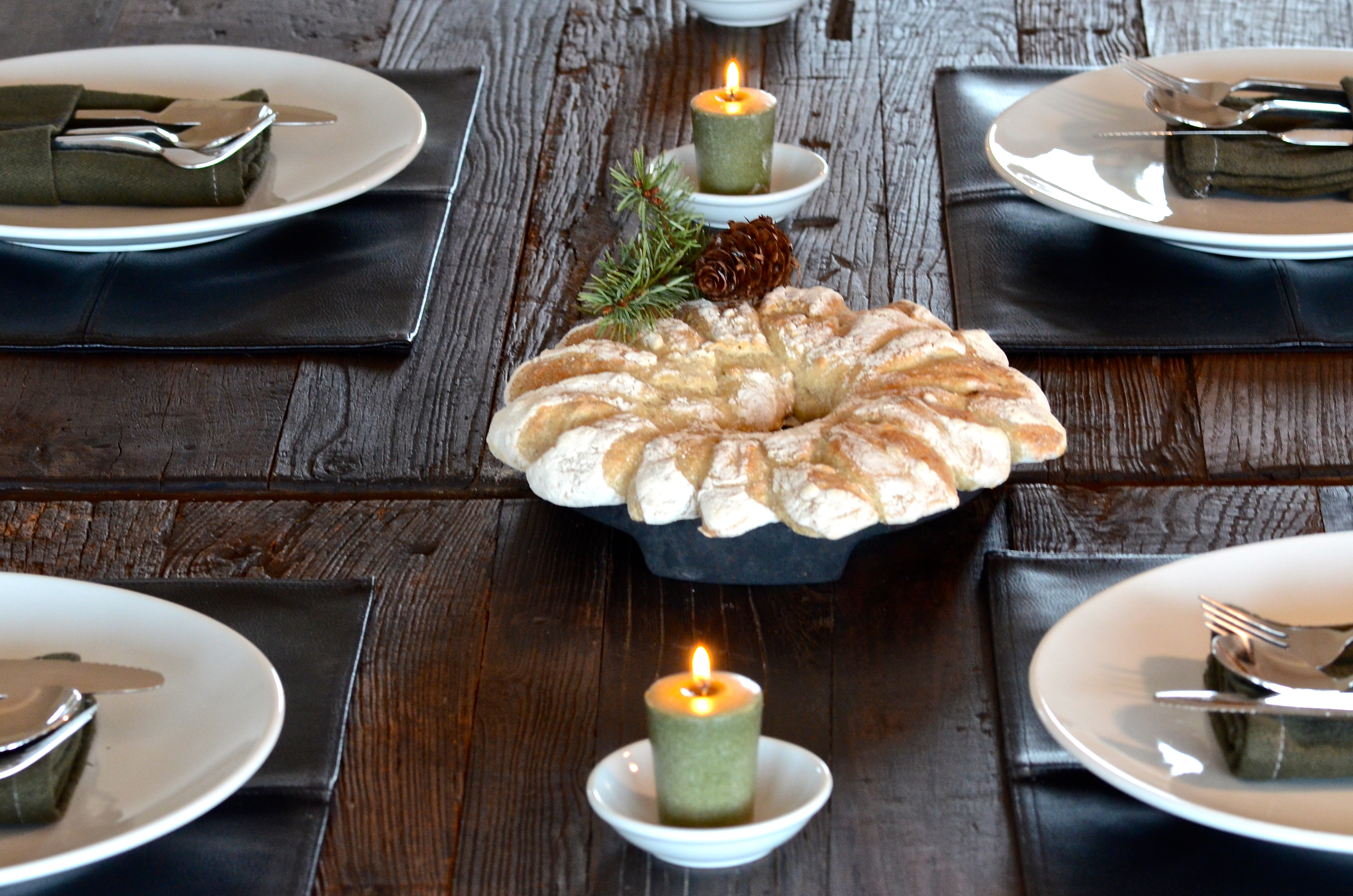
Allan is coming home tonight.  We have been apart for five weeks, the longest time in our 30 years of marriage.  A solstice feast is being prepared that is full of symbolism for us.  There will be crab bisque made from the dungeness crab we harvested when the sun barely set last summer.  We will have some other bright flavors with the meal like a citrus salad and a tart cranberry panna cotta for dessert, and for an edible centerpiece, I’ve made this bread wreath.  Allan will be bringing the French champagne for the sparkle.

Bread 2

  It will be true yuletide, or time to celebrate, as we sit around our table together tonight.

White Candles

Bread Wreath

From Martha Stewart, November 2013

Ingredients

    • 1 cup all-purpose flour, plus more for dusting and sprinkling
    • 1/2 cup rye flour
    • 1 cup plus 2 tablespoons bread flour
    • 2 teaspoons coarse salt
    • 1 1/2 teaspoons dry active yeast (from one 1/4-ounce envelope)
    • 1 1/4 cups warm water (110 degrees), plus 1 cup water for baking dish

Directions

  1. Mix together 3/4 cup all-purpose flour, the rye and bread flours, salt, yeast, and warm water in a large bowl with a wooden spoon. (Dough will be sticky.) Cover bowl with a kitchen towel and let rise in a warm place until doubled in size, 2 to 2 1/2 hours. Refrigerate dough in bowl until cold, about 1 hour.
  2. Preheat oven to 475 degrees, with a pizza stone or inverted rimmed baking sheet on rack in top position and a baking dish on rack in lowest position. Transfer dough to a lightly floured work surface and sprinkle with remaining 1/4 cup all-purpose flour. Knead briefly to incorporate, then form into a smooth ball. Return to bowl, cover with towel, and refrigerate 30 minutes.
  3. Invert a cookie sheet, cover with parchment, and dust with all-purpose flour. Place dough in center. Poke a hole in center of dough with your thumbs and stretch it until dough measures 9 inches in diameter and hole measures 4 1/2 inches in diameter. Generously sprinkle with all-purpose flour and let rest, uncovered, 15 minutes. Using kitchen shears, cut 14 deep Vs into top of dough, going almost all of the way through. Pull points of cut Vs away from center to create 14 leaves around wreath. Let rest, uncovered, 15 minutes.
  4. In one quick motion, slide wreath on parchment onto pizza stone, then pour water into baking dish. Bake until bread is golden brown, about 20 minutes. Slide wreath on parchment onto a baking sheet, then slide wreath off parchment onto a wire rack. Let cool at least 30 minutes before serving. Bread is best eaten same day it is made.